
What Age Should My Child Start Music Lessons?
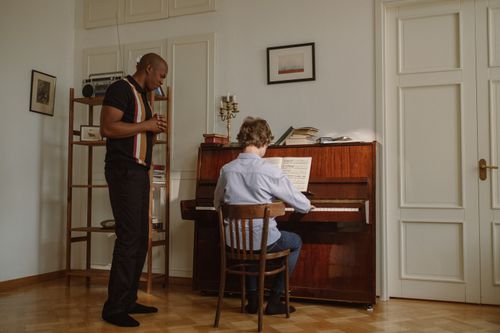
Parents ask me the age question more than any other: what age should my child start music lessons? The short answer is seven — one minimum age, the same for every instrument I teach. The better answer is that age is a poor proxy. I have taught a focused seven-year-old who was ready and a distracted eleven-year-old who was not. What matters is four things you can observe at home, and they are listed below.
Age by instrument
| Instrument | Minimum age | Why |
|---|---|---|
| Singing | 7+ | The instrument is theirs already; the work is pitch, breath and confidence |
| Ukulele | 7+ | Soft nylon strings, two-finger chords, a song in the first lesson |
| Piano and keyboard | 7+ | Reading two staves needs a little reading confidence |
| Guitar | 7+ | Steel strings need finger strength and hand span — a shorter-scale guitar bridges the gap |
| Indian classical vocal | 7+ | Riyaz and ear-training reward sustained attention |
| Harmonium | 7+ | Bellows control needs both hands working independently |
| Music theory | 7+ | Best learned alongside an instrument, not before it |
These are starting points, not rules. If a child is begging to start guitar at seven, a shorter-scale guitar and a patient first term work fine; see the children's lessons page for how the early months are paced.
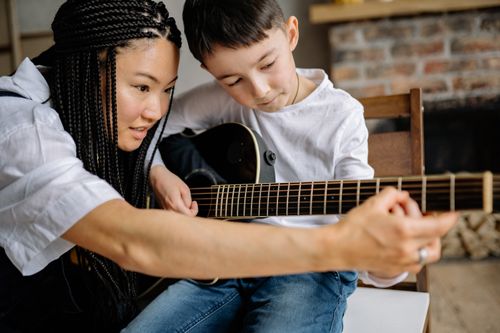
The four signs of readiness
- They can sit with one thing for ten minutes. Not still — just engaged. A lesson is 45 to 60 minutes; ten minutes of focus at home is the honest minimum.
- They can tell you when something sounds wrong. This is the beginning of an ear, and it matters more than any theory.
- They can follow a two-step instruction. "Fingers here, then strum down" — most of the first year is exactly this.
- They asked. A child who asked is worth three terms of perseverance. A child who has been enrolled rarely is.
What starting earlier does not buy you
Starting a year or two early does not produce a better musician at fourteen. I have seen the opposite often enough to say it plainly: children pushed too early learn to associate music with correction, and they stop at eleven or twelve. The children still playing at eighteen are usually the ones who started when they were ready and never had to be made to practise.
What does help early is listening. Singing at home, a household with music in it, a child who knows what a chorus is — that foundation is worth more than two years of formal lessons started too soon. When your child is ready for a benchmark, the graded syllabi are published openly by ABRSM, Trinity College London and RSL Awards.
A realistic first year
- Months 1–3: posture, tuning, five or six chords or notes, three simple songs. The goal is that it feels good.
- Months 4–6: changing between chords cleanly, first piece with two hands or a full strum pattern, playing for someone else.
- Months 7–12: simple notation or tab, a repertoire of eight to ten pieces, and a first graded exam if the child wants one — see the ABRSM guide.
Is seven too late to start?
No. Seven is the age I teach from, on every instrument. Adulthood is not too late either — see learning as an adult.
Should my child learn an instrument before music theory?
Almost always, yes. Theory sticks when it explains something your hands already do. It becomes essential at Grade 5, which is the prerequisite for Grades 6 to 8 practical.
How long should a child's lesson be?
45 to 60 minutes, one-to-one. Younger beginners often do better at the shorter end; the free one-to-one introduction tells you which.
What if my child wants to quit?
Ask why before you decide. Usually it is the practice, the piece, or the pace — all fixable. Quitting in the first six weeks is different from quitting after two years.
Try a lesson before you decide.
One live lesson, one-to-one with me, 15 to 30 minutes, and it is free. If it is not for you, nothing is owed.