
How to Pass ABRSM Grade 5 Theory: A 12-Week Study Plan

ABRSM Grade 5 theory is the single most useful exam a school-age musician sits, because passing it unlocks Grades 6 to 8 practical — no Grade 5, no entry. It is also the exam candidates prepare for worst, usually by working through a past paper a fortnight before and hoping. Twelve weeks, in the order below, is a calmer and far more reliable route. The full route through the grades is set out in my ABRSM guide.
What the paper actually tests
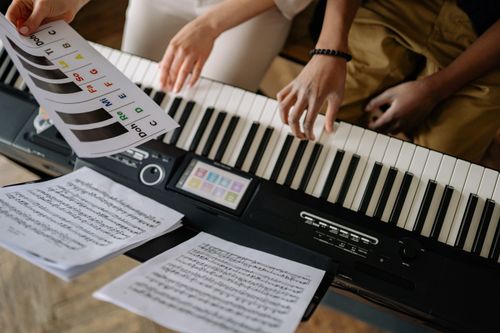
- Rhythm and time signatures — simple, compound and irregular, plus grouping notes correctly.
- Pitch and keys — major and minor scales up to four sharps and flats, technical names, key signatures.
- Intervals — naming and writing them, including compound intervals.
- Chords and cadences — triads, inversions, the four cadences, and identifying chords in a passage.
- Terms, signs and instruments — Italian terms, orchestral instruments, transposition, clefs.
- Composition — a short melody for an instrument, or harmonising a given melody.
The 12 weeks
| Weeks | Topic | What to finish with |
|---|---|---|
| 1–2 | Note values, rests, time signatures, grouping | Writing any rhythm correctly from dictation |
| 3–4 | Major scales, key signatures to 4 sharps/flats | Writing any major scale from memory |
| 5 | Minor scales — harmonic and melodic | All three forms in every key so far |
| 6–7 | Intervals, simple and compound | Naming an interval in under five seconds |
| 8–9 | Triads, inversions, cadences | Harmonising a simple four-bar phrase |
| 10 | Terms, signs, instruments, transposition | Two full past papers, timed |
| 11–12 | Composition question + past papers under exam conditions | Three papers at 66/75 or better |
The marks most candidates drop
- Grouping in compound time. Six-eight behaves differently from three-four. Drill it until it is automatic.
- Harmonic vs melodic minor. The raised seventh is the whole point of harmonic minor; forgetting it costs a mark in nearly every question.
- Compound intervals. A major ninth is a major second plus an octave. Count the letter names, then the semitones.
- The composition question. It is a quarter of the paper and the most practised candidates still leave it to the last fifteen minutes. Give it thirty.
- Reading the question. "Write" versus "name" versus "identify" — a surprising number of marks are lost to not doing what was asked.
How to study it
Twenty minutes a day beats two hours on a Sunday, and writing beats reading. Every topic above should end with you putting pencil on paper. Work the ABRSM past papers in the final fortnight under timed conditions — the exam is two hours, and the clock is the thing candidates are least prepared for.
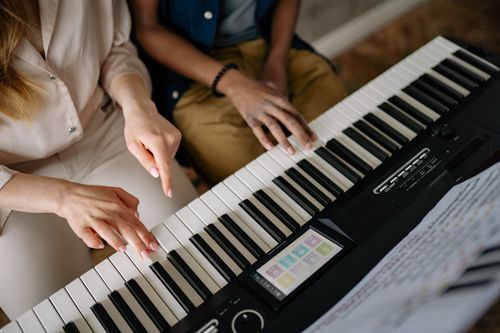
Theory is also far easier to learn alongside an instrument than in isolation. If your child is learning piano or guitar, the scales and chords in the paper are already under their fingers — see the music theory lessons or a group theory class if you would rather they learn it with other students.
Is Grade 5 theory still required for Grades 6 to 8?
It is required for Grades 6 to 8 practical at ABRSM. It does not apply to Grades 1 to 5, and it is not required for the Performance Grades.
Can you take Grade 5 theory online?
Yes — ABRSM runs digital theory exams. Ask when you register, as sessions fill quickly.
How long does the exam last?
Two hours, 75 marks, with a pass mark of 50 (66 for a merit, 60 for a pass in the older 100-mark scheme — check the current syllabus).
Does Trinity require it?
No. Trinity College London has no theory prerequisite for its graded exams, which is one reason some students choose it.
What if I fail?
You resit. The mark is not carried into anything else, and most candidates who fail do so by a handful of marks on one topic.
Try a lesson before you decide.
One live lesson, one-to-one with me, 15 to 30 minutes, and it is free. If it is not for you, nothing is owed.