
ABRSM, Trinity and Rockschool: An Honest UK Exam Guide for Parents
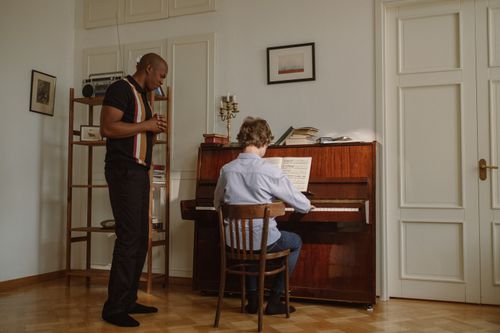
For hundreds of thousands of UK families, the words ABRSM exam mark out the year: the winter of rehearsing, the spring of mock exams, the day the examiner writes the report. It is the most common reason a UK family looks for a music teacher in the first place — and the most common source of confusion about what is actually being prepared for.
This guide explains, honestly, how the UK's graded exam system works, what a practical exam contains, the theory rule that catches families out, how the digital exam routes fit students who learn online — and the timelines worth budgeting, not the ones marketing pages promise.
The three boards you will meet in the UK
ABRSM is the biggest, but it is not the only one. All three below are Ofqual-regulated and all three are taught here:
| Board | Best known for | How it differs |
|---|---|---|
| ABRSM | The classical graded route — piano, strings, guitar, voice, brass, woodwind, theory | Grades 1–8, then diplomas (ARSM, LRSM, FRSM). Sight-reading from Grade 1. Around 600,000 candidates a year, in more than 90 countries. |
| Trinity College London | Classical, jazz and rock & pop syllabuses, and digital exams | Grades 1–8 plus ATCL, LTCL and FTCL diplomas. Sight-reading begins at Grade 6, and it offers digital exams in several subjects. Over 850,000 candidates a year. |
| Rockschool (RSL Awards) | Contemporary music — electric and acoustic guitar, bass, drums, vocals, piano and music production | Grades 1–8 with a repertoire-led, band-based feel; a strong choice for a teenager who wants to play the music they listen to. |
If you are unsure which to choose: ABRSM suits a student heading toward classical study or a conservatoire, Trinity suits one who wants more flexibility in repertoire, and Rockschool suits one whose heart is in a band. A good teacher will tell you honestly which fits your child — and it is perfectly normal to switch.
How the ABRSM ladder is built
The ABRSM — the Associated Board of the Royal Schools of Music — has set music education standards in the UK since 1889. Its ladder runs Initial Grade (formerly the Preparatory Test), then Grades 1 to 8, then the diplomas: ARSM (a performance diploma), then LRSM and FRSM. Each grade has a published syllabus: a repertoire list, technical requirements (scales and arpeggios), aural tests and sight-reading.

Two things worth understanding early. First, it is not a competition — it is a standard, and it is the same standard wherever you sit it. Second, it is genuinely useful: ABRSM grades are widely recognised, and the higher grades with their theory requirement are commonly part of a serious music application. A student who works through the grades has a paper trail of real musical development, year by year.
What a practical exam actually contains
Parents often imagine the exam is only playing pieces. It is more than that — and it is more forgiving than families fear. A standard ABRSM practical exam is marked out of 150, with 100 for a pass, 120 for a merit and 130 for a distinction:
| Component | What it involves | What the examiner is really listening for |
|---|---|---|
| Pieces (3) | Three pieces chosen from the syllabus lists for the grade | Accuracy, but also tone, rhythm, style and musical character |
| Scales and arpeggios | The technical requirements published for the grade | Fluency and evenness — the foundations the pieces stand on |
| Sight-reading | An unseen passage, played after a short look | Preparation habits, counting, keeping going after a slip |
| Aural tests | Clapback, melody playback, interval and chord recognition | Whether the student hears music, not just reads it |
Read the examiner's written report as a diagnosis, not a verdict: it tells you exactly what the next grade will be built on.
The theory rule that catches families out
Here is the part that surprises people. It is not one theory exam per grade. The ABRSM rule is this: to enter a Grade 6, 7 or 8 practical exam, a student must already hold Grade 5 theory — or Grade 5 Practical Musicianship, or a relevant Grade 5 jazz qualification, or a qualifying GCSE. Theory has its own Grades 1 to 5, examined in a separate written (now often online) paper.
The practical lesson families learn: start theory in Grade 4, not Grade 5. A student who meets theory for the first time at Grade 5 is usually delayed six months to a year. A teacher who weaves theory into every lesson from the beginning makes the requirement a formality instead of a wall.
Digital and performance exams — a genuine option if you learn online
This is the change that matters most for families whose lessons happen over a screen. ABRSM offers Performance Grades (from Initial to Grade 8) assessed from a video recording the family submits, with no scales, sight-reading or aural tests — the mark is based entirely on the performance. Trinity offers its own digital exams in several subjects. Both are a good fit for a student who is well prepared but finds the exam room intimidating, and both can be recorded with equipment a family already owns.
I prepare students for both routes — the in-person exam and the digital one — and I will say honestly which suits a particular student better.
How online lessons prepare a student for a graded exam
Exam preparation is cumulative work over time — supported by lessons arranged to the agreed plan. In practice it looks like this:

- A fixed regular lesson, all year — not a cram in March. Grades are built, not purchased.
- Camera on the hands and posture for technique, with recorded lessons so the student can practise exactly what was taught.
- Mock exams, in exam order — pieces first, then scales, sight-reading and aural — with honest examiner-style comments.
- Aural and sight-reading work in every lesson, because those are the marks most students leave on the table.
- Theory taught alongside the practical work, so the Grade 5 requirement arrives already met.
- A written practice plan every week, built around the student's real schedule — 20 to 30 minutes daily beats a weekend marathon.
Families register for the exam themselves with the board: the boards publish their own session dates, deadlines, entry requirements and fee schedules, and those fees are paid directly to them. My job is the preparation; the board is the examiner.
A realistic timeline
Honest ranges, for a child practising 20 to 30 minutes a day — the numbers experienced teachers use, not marketing copy:
| Stage | Typical preparation per grade |
|---|---|
| Initial Grade to Grade 3 | 6 to 12 months per grade |
| Grades 4 and 5 | 8 to 12 months per grade (theory begins alongside) |
| Grades 6 to 8 | 12 to 18 months per grade, with Grade 5 theory already held |
| ARSM diploma | 18 months or more of serious study |
And one piece of advice worth more than any timeline: do not rush the first exam. A confident Grade 2 result — one where the examiner's report is full of forward-looking notes — builds a musician. A scraped-through Grade 4 builds a child who quits at Grade 5.
The questions worth asking any teacher
- Which board and which grades have you prepared students through — and what did the examiner reports say?
- When would you enter my child for the first exam, and why that session?
- What does a normal practice week look like at this grade?
- How do you handle the Grade 5 theory requirement — inside the lesson, or separately?
- Would you recommend the in-person exam or a digital performance grade for my child?
- What happens if the mock exam says the student is not ready? (The best answer is: I wait. Ask for it.)
I teach the ABRSM, Trinity and Rockschool syllabuses for piano, guitar, voice and theory, integrated into the same agreed lesson routines as everything else — and the free one-to-one introduction is exactly where those questions get answered, honestly, before anything is paid.
What about students who also study Indian music?
Many families here do both: graded piano or guitar alongside Indian classical vocal or harmonium. The habits reinforce each other surprisingly well — ear training, rhythm, and the discipline of a daily practice. The two systems are examined differently but aim at the same thing: a student who can actually hear, and actually play.
Can a student prepare for ABRSM exams entirely online?
Yes. Weekly one-to-one lessons, mock exams and theory support all happen live online. The exam itself is either taken in person at a board examination centre or submitted as a video for a digital performance grade — families register directly with the board.
When should a beginner start graded exams?
Whenever the foundations are solid — often after a year of lessons for a child. There is no requirement to begin at Grade 1; many students enter first at Initial Grade or Grade 2. The free one-to-one introduction includes an honest readiness assessment.
Is Grade 5 theory really required?
For Grades 6, 7 and 8 practical, yes — Grade 5 theory, Grade 5 Practical Musicianship or an accepted alternative must be held first. That is why theory is taught alongside the practical work from the start here, rather than bolted on late.
How much do the exams cost?
One-to-one monthly plans are 4 classes for £40, 8 for £72 or 12 for £102; each class is 45–60 minutes. Group is eight fixed classes monthly for £48 per student, 60–90 minutes each, in batches of 5–8. Payment is in advance by PayPal, Remitly or Western Union. The free introductory lesson is one-to-one and 15–30 minutes.
My child plays guitar, not piano. Do graded exams apply?
Yes — ABRSM covers guitar, voice and most orchestral instruments, not only piano, and Rockschool's guitar, bass, drums and vocal syllabuses are built specifically around contemporary music.
Do you teach Rockschool as well as ABRSM?
Yes. If a student's repertoire is contemporary — electric guitar, drums, pop vocals — Rockschool is often the better fit, and I will say so rather than forcing a classical syllabus onto them.