
How Long Does It Take to Learn Guitar? A Realistic Timeline
Every beginner wants the same answer to how long it takes to learn guitar, and most of what they find online is a lie of omission: "play your first song in 10 minutes" is true and useless. Here is the honest version, measured against what students of mine across the UK have actually done. The variable is not talent. It is whether you practise twenty minutes a day.
The timeline, honestly
| After | What you can actually do | What it takes |
|---|---|---|
| 4 weeks | Three or four open chords, two changes that don't stop, one simple song | 15–20 minutes a day, five days a week |
| 3 months | Eight chords, clean changes at tempo, four songs start to finish, basic strumming patterns | 20 minutes a day |
| 6 months | Barre chords, a simple fingerstyle pattern, playing along with a recording, first jam with someone | 20–30 minutes a day |
| 12 months | Two dozen songs, reading tab, the pentatonic scale in three positions, improvising a little, Grade 2–3 standard | 30 minutes a day |
| 2 years | Grade 4–5 standard, playing in a group, learning songs by ear | 30–45 minutes a day |
What actually slows people down
- Chord changes, not chords. Everyone blames the F barre. The real wall is moving between any two chords in time. Practise the change, slowly, with a metronome.
- A guitar that fights back. High action and heavy strings on a cheap instrument will make a beginner's hands hurt. A £10 setup does more than a £300 upgrade.
- Practising only the songs. Songs are the reward. Technique — changes, timing, scales — is the work. Twenty minutes split between them beats an hour of songs.
- Practising without a beat. Timing is the difference between playing guitar and making noises on one. Use a metronome from week one.
- Quitting at month three. This is the peak. It passes.
How to get there faster
- Practise regularly in short bursts rather than two hours on a Sunday — the brain consolidates overnight.
- Record yourself for thirty seconds once a week. You will hear the tempo problem you cannot feel.
- Learn one song you actually love, alongside the graded material. It is what keeps you playing.
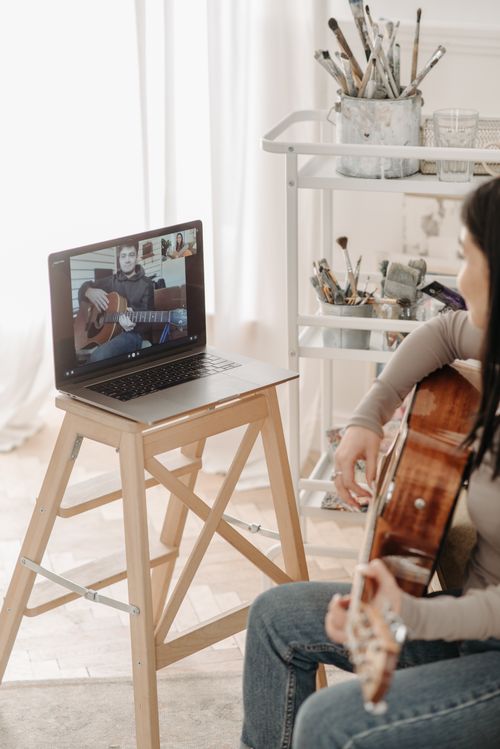
- Have a teacher watch your hands. Self-taught players carry the same three bad habits for years — aguitar teacher spots them in one lesson.
- Play with a recording by month two. It teaches timing faster than any exercise.
Is a year to Grade 2 realistic?
Yes, comfortably, with thirty minutes a day and regular lessons. One-to-one lessons can be scheduled 24/7, subject to available slots and mutual agreement. Days and times are agreed before enrolment; individual calendar dates can be arranged flexibly later. Group classes follow their fixed batch schedule. Faster is possible; slower is fine. Graded exams are a useful measuring stick, not a race — Rockschool suits contemporary players, ABRSM suits classical, and Trinity sits between them. Pick the syllabus whose repertoire you would actually enjoy playing.
Can I learn guitar at 40 or 50?
Yes. Adults learn chord vocabulary faster than children; they just need their hands to catch up. Progress in the first three months is often quicker than a child's.
Acoustic or electric first?
Acoustic teaches strength and does not need an amp; electric is easier on the fingers. Either is fine — start with the one you will pick up.
How long until I can play in a band?
Around six months of steady practice: barre chords, keeping time, and knowing the pentatonic scale.
Do I need to read music?
No. Tab and chord charts will take you a very long way. Reading opens the door to classical repertoire and higher grades.
What is a realistic practice schedule?
Twenty minutes, five days a week, beats an hour once a week. Consistency compounds; cramming does not.
Try a lesson before you decide.
One live lesson, one-to-one with me, 15 to 30 minutes, and it is free. If it is not for you, nothing is owed.